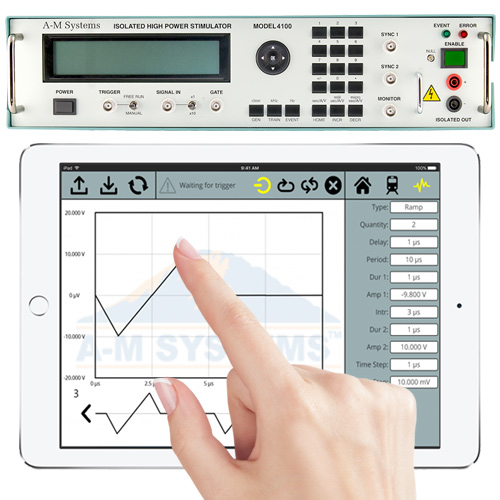

| The
Model 2100 Isolated Pulse Stimulator has been designed for
a wide
variety of physiological stimulation requirements. A flexible,
accurate system, it can be operated free-running, manually
triggered, or externally triggered. A TRIG indicator lights
when an acceptable trigger is received. An EVENT indicator
lights whenever a pulse is delivered.
The operator describes the desired pulse train by setting
four times: The delay time (time between trigger and the first
pulse); train burst width time; individual pulse duration;
and interpulse period (the duration of a single pulse on/off
cycle). If the period is set to be shorter than the pulse
duration, a timing overlap error LED indicator warns the user
of this condition.
For ease of use, the delay may be set to “none”,
so that no extra delay occurs between trigger and pulse output.
The burst width may be set to “single,” so that
only a single pulse is output for a single triggering event.
This has the additional effect of suppressing the post-pulse
delay associated with the inter-pulse period, thus allowing
the stimulator to become immediately retriggerable, instead
of waiting until the end of the period. The pulse duration
may be set to “square”, automatically setting
the duration to one half of the period.
The times are easily and rapidly set with leverwheel switches,
which are much more convenient than thumbwheel switches. The
timing accuracy is dependent only on a 10 MHz internal crystal
clock which has an absolute accuracy of better than 0.02%
and timer-start jitter of ±250ns (±2.5µs
in the 100 second range).
The full-scale amplitude accuracy is 1%, with a voltage-mode
output impedance of less than 60 Ohms, and a current-mode
output
impedance of at least 1 MegOhms. The output pulses may be
monophasic (selectable polarity) or biphasic, in which a
positive pulse
is immediately followed by a negative pulse. The baseline
amplitude is independently adjustable up to ±10%
of the pulse amplitude range.
|